
NEW PUPPY GUIDE
Introduction
Welcome to our New Puppy Guide! This guide is designed for first-time puppy owners and anyone bringing home a new puppy. Whether you’re new to dog ownership or simply want to ensure a smooth transition for your newest family member, you’re in the right place. In this comprehensive guide, we’ll cover everything you need to know about preparing for your puppy’s arrival, nutrition, potty and crate training, health and wellness, socialization, early training, and more. Our goal is to help you feel confident and supported as you embark on this exciting journey.
Congratulations on your new puppy! We are excited to help you embark on this exciting journey with your newest family member. A warm welcome to all new puppy parents—bringing home your first puppy is a unique and rewarding experience, and we’re here to support you every step of the way.
Before your puppy arrives, it’s important to prepare your home and family for the transition. Taking time to get ready ensures a smooth adjustment for both you and your new furry friend, helping everyone settle in comfortably.
Below you will find several resources that I hope you will find very helpful. I would recommend that you read through all of it within a week of your pick-up—especially if you’re a new dog owner. If you establish some ground rules in the very beginning, it will increase your chances of a well-behaved dog. Our step by step guidance is designed to help new puppy parents navigate the early days with confidence and clarity.
To access the PDF version of our pickup brochure guide, Click Below!
The first 48 hours with your new puppy are crucial for adjustment, as everything is new and can be overwhelming for them. Many puppies go through a honeymoon phase where they seem calm and well-behaved at first, but as they settle in, their true personalities emerge and they may become more active. It’s also normal for new puppy parents to experience the puppy blues—feelings of frustration or overwhelm—as everyone adapts to the changes. Remember, you’re not alone, and support is always available.
Pre-Puppy Arrival Preparations
Puppy-Proofing Your Home
Puppy-proofing your home is an essential first step before your puppy arrives. Puppies are naturally curious and will explore their environment with their mouths, making it essential to remove or block access to dangerous items such as:
- Electrical cords
- Small objects that could be swallowed
- Toxic plants
- Household chemicals
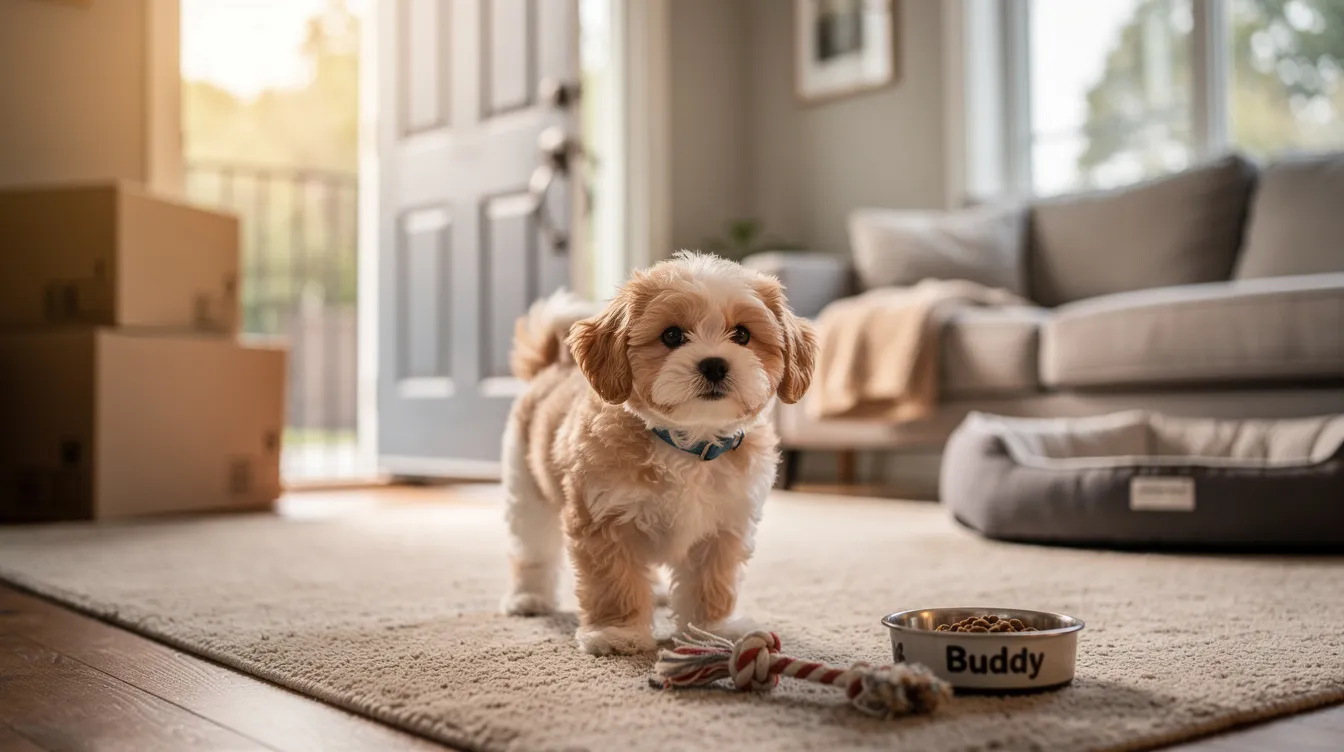
Using baby gates or exercise pens can help restrict access to unsafe areas in your home, ensuring your puppy remains safe while exploring their new environment. Creating a designated puppy zone with a soft bed, toys, and access to clean water helps your puppy feel secure and establishes a place where they can rest and relax, and many of these same principles apply when preparing your home for the arrival of an Aussiedoodle puppy.
Gathering Supplies
Make sure you have all the necessary supplies ready, including:
- Food and water bowls
- Puppy food
- Crate or playpen
- Bed and blankets
- Chew toys and interactive toys
- Collar, leash, and ID tag
- Cleaning supplies and enzymatic cleaner
With your home prepared and supplies on hand, you’ll be ready to welcome your new puppy and start building a strong foundation for their well-being.
By following this New Puppy Guide, you’ll be well-equipped to provide your puppy with the best possible start in life. Remember, patience, consistency, and positive reinforcement are key to raising a happy and healthy dog. Enjoy every moment with your new furry friend!
NUTRITION
Choosing Puppy Food
At Bliss Kennels, we strongly believe in proper nutrition for your puppy. It’s essential to choose a high quality dog food specifically formulated for growing puppies to support their growth and development. We feed our pups TLC three times a day. Puppies have higher calorie and nutrient needs than adult dogs, so their food should be complete and balanced, providing all the necessary nutrients in the correct proportions to support their growth and development.
Feeding Schedule
For the most part, the breeds we produce will always be sensible eaters, stopping when they’ve had the right amount. Feeding three small meals per day helps regulate their digestive system and maintain a healthy weight. Simply follow the guidelines on the bag which are weight and age related regarding the amount of food.
Monitoring Growth
It’s important to avoid overfeeding to prevent health issues such as obesity and bone development problems, and remember that abrupt changes in diet or inappropriate foods can cause an upset stomach. Monitor your puppy's growth and adjust feeding routines as needed to support healthy development. When your puppy is taken home we will instruct you what they are accustom to at that point.
To read more about our favorite food, visit TLC Pet Food
POTTY & CRATE TRAINING
Crate Training Basics
By 8 weeks your puppy can “hold it” 4 hours during the day and about 6-8 at night. Puppies and adult dogs love their “den” and like to keep it clean, so a crate can be a helpful tool for potty training.
A crate is a secure, enclosed space that mimics a den-like environment for your puppy. It serves as a safe space where your puppy can rest, relax, and feel secure. Crates or playpens are also valuable aids in house training, as they help teach your puppy to hold their bladder and prevent accidents when you cannot supervise them. Creating a designated puppy zone with a soft bed, toys, and access to clean water helps your puppy feel secure and establishes a place where they can rest and relax.
We recommend using a divider to adjust the crate size as your puppy grows, and many pups like a blanket draped over their crate. However, many families elect to not use a crate, and we also believe this is an acceptable practice. Basically, our view on crate training is neutrality. It works for some and not for others. Some families like the idea while others do not. There are pros and cons either way and it ultimately boils down to what each family feels comfortable with. It’s important to start potty training as soon as your puppy comes home, using the crate for short periods to help them learn to hold their bladder. Crate training and house training are closely related, as the crate encourages your puppy to keep their sleeping area clean and helps establish good potty habits.
Potty Training Routine
Potty accidents and inevitable accidents are common in the early days, so be prepared with cleaning supplies and enzymatic cleaners to keep your home fresh and stress-free.
Follow these steps for successful potty training:
- Take your pup out frequently during the day, especially after meals, naps, and playtime.
- Use the same spot outside each time to help your puppy associate the area with going potty.
- Reward your puppy with praise and sometimes a treat—positive praise goes the furthest.
- Supervise your puppy closely indoors to prevent accidents.
- Gradually increase the time between potty breaks as your puppy matures to help them learn to hold it overnight.
Establishing a structured routine for feeding, potty breaks, playtime, and training will help your puppy feel secure and understand what to expect in their new environment. Having food and most water up 3-4 hours before bedtime helps to eliminate the need to go “out” during the night. Adjusting to life without siblings might take a couple of nights.
Handling Accidents
- Clean up promptly with enzymatic cleaners to remove odors and discourage repeat accidents.
- Stay patient and consistent—accidents are a normal part of the learning process.
HEALTH & WELLNESS
First Vet Visit
We recommend scheduling your puppy's first vet visit within a week of receiving your new puppy. This initial appointment is an important milestone in your puppy's first days at home. During the first vet visit, your veterinarian will:
- Perform a thorough physical exam to check for any health concerns and congenital issues
- Begin your puppy's vaccination schedule
- Discuss preventive care, including vaccinations and deworming.
Vaccination Schedule
Puppies typically start their vaccination schedule around 6 to 8 weeks of age, with boosters given every 2 to 3 weeks until they are 16 weeks old. The schedule generally includes:
- 1st vaccine: 6-8 weeks
- 2nd vaccine: around 9 weeks
- 3rd and final vaccine: 3 weeks after the second
At 8 weeks, flea and tick preventative should be started as well as a monthly wormer with a heartworm medicine in it. We encourage you to avoid strangers' dogs, potty areas at rest stops, and other public areas until your puppy is fully vaccinated.
Grooming Needs
Doodles should not shed. Since they will have hair and not fur, hair breakage will occur so you will find tumbleweeds in the house. This should not be confused with shedding. F1 tend to have more hair breakage because they have a wavy coat which is more susceptible due to being more free-flowing. F1b that have a genetic composition with a preponderance of poodle genes will have more of a curl which will make the hair less susceptible to breaking since its wound closer to the body. However, not all F1b will have the same genetic composition in terms of poodle to retriever genes. Most Doodles visit the groomer about once every 2-4 months. Rely on your groomer for basic maintenance tips (brushing, trimming nails, cleaning ears etc.). Take a picture of the look you have in mind.
All our puppies are 100% guaranteed under the NJ Pet Lemon Law Act for the first 6 months after purchase
Spaying and Neutering
This is a topic with much controversy and conflicting reports. There is a plethora of information out there for each family to make their own conscientious decision as to spaying or neutering their dog. With that said, most families do elect to do it. We highly recommend you do not have this performed at 6 months. 9 months is the earliest we would have you concede to it, but would prefer 12 months or more. Again, do your own due diligence on this hotbed topic.
SOCIALIZATION & EARLY TRAINING
The Importance of Socialization
Socialization is key to raising a well-rounded puppy, and it should begin as early as possible, ideally between 3 and 14 weeks of age. During this critical period, puppies are most receptive to new experiences and learning about the world around them, which is especially important when raising mini Goldendoodle puppies with love.
- Gradually expose your puppy to different environments, sounds, surfaces, and people to facilitate proper social development.
- Use positive reinforcement, such as treats and praise, to reward calm and confident behavior when having new experiences.
- Puppy classes are strongly encouraged for training and socialization, as they provide a controlled environment for puppies to learn and interact with others, and you can also benefit from broader dog breeds and pet care resources that address training and lifestyle tips for different doodle mixes.
Early Training Basics
Early training is crucial for puppies as it helps establish boundaries and teaches them basic commands like "sit," "stay," and "come." Puppies learn best through short, frequent training sessions to keep them engaged and avoid overwhelming them.
- Keep training sessions brief (5-10 minutes) and fun.
- Use positive reinforcement techniques, such as treats and praise, consistently during training sessions.
- Practice basic commands daily and gradually introduce new skills as your puppy progresses.
Establishing a Routine
Puppies require a structured routine that includes feeding, potty breaks, playtime, and training to help them feel secure and understand what to expect in their new environment. Establishing a routine for feeding, potty breaks, and playtime is important as it helps your puppy feel secure and understand what to expect in their new home.
With a strong foundation in socialization and early training, your puppy will be well on their way to becoming a happy, confident, and well-behaved companion, especially when you start your journey by asking
top questions to Labradoodle breeders during your initial contact to ensure you’re working with an ethical, knowledgeable breeder.
CHEWING & TOYS
Why Puppies Chew
Pups love and need to chew. Chew toys and interactive toys also provide important mental stimulation for your puppy, helping to keep them engaged and support healthy development.
Choosing Safe Chew Toys
Our simplest recommendation is having a lot of chew toys available that your pup is allowed to chew on. Divert them from shoes, children’s toys, and furniture by substituting an acceptable replacement. Do not buy chew toys made in China due to the fact that many are made from materials that can be harmful to your pup.